NLRB Stats Archive › Annual Reports › FY1960 › Collective-Bargaining Elections by Affiliation of Participating Unions, Fiscal Year 1960
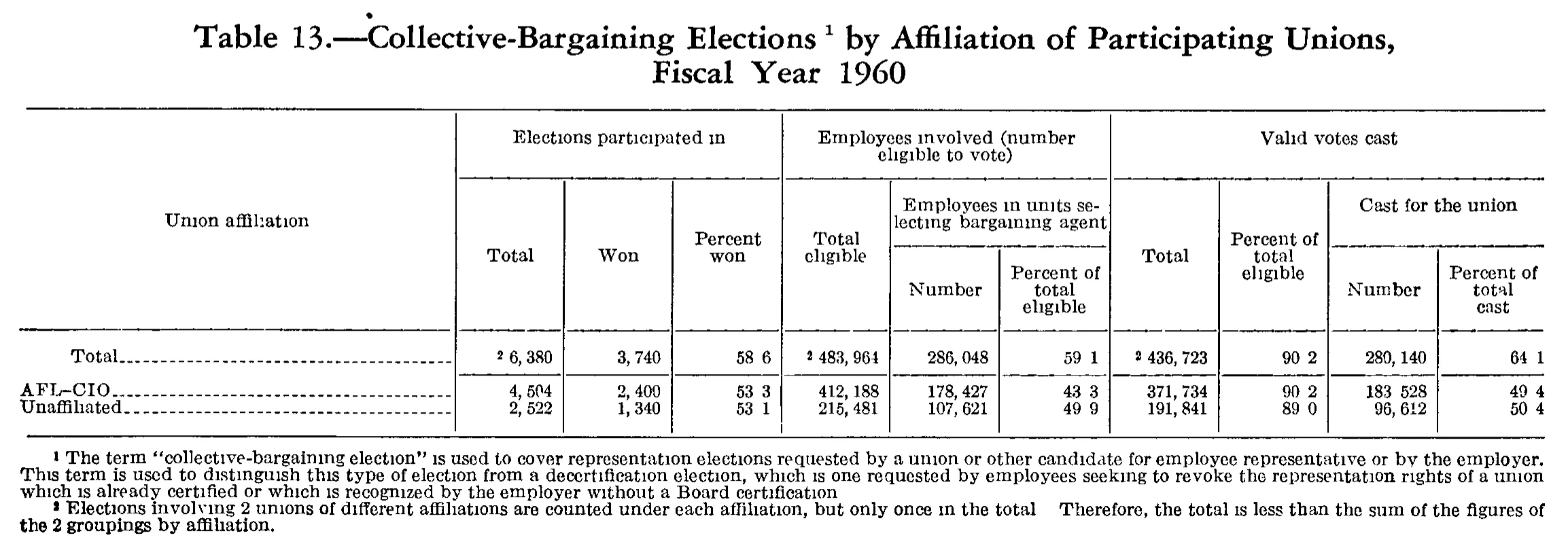
Collective-Bargaining Elections by Affiliation of Participating Unions, Fiscal Year 1960
| Union affiliation | Elections participated in | Employees involved (number eligible to vote) | Valid votes cast | |||||||
|---|---|---|---|---|---|---|---|---|---|---|
| Union affiliation | Total | Won | Percent won | Total eligible | Employees in units selecting bargaining agent | Total | Percent of total eligible | Cast for the union | ||
| Union affiliation | Total | Won | Percent won | Total eligible | Number | Percent of total eligible | Total | Percent of total eligible | Number | Percent of total cast |
| Total | 6,380 | 3,740 | 58.6 | 483,964 | 286,048 | 59.1 | 436,723 | 90.2 | 280,140 | 64.1 |
| AFL-CIO | 4,504 | 2,400 | 53.3 | 412,188 | 178,427 | 43.3 | 371,734 | 90.2 | 183,528 | 49.4 |
| Unaffiliated | 2,522 | 1,340 | 53.1 | 215,481 | 107,621 | 49.9 | 191,841 | 89.0 | 96,612 | 50.4 |
- 1 The term "collective-bargaining election" is used to cover representation elections requested by a union or other candidate for employee representative or by the employer. This term is used to distinguish this type of election from a decertification election, which is one requested by employees seeking to revoke the representation rights of a union which is already certified or which is recognized by the employer without a Board certification.
- 2 Elections involving 2 unions of different affiliations are counted under each affiliation, but only once in the total. Therefore, the total is less than the sum of the figures of the 2 groupings by affiliation.
0 of 18 figures sit in a row or column sum that works out.
Reader’s notes
p. 208. The table has 11 columns: stub plus three spanner groups (Elections participated in = 3 cols; Employees involved = 3 cols, of which the last two sit under "Employees in units selecting bargaining agent"; Valid votes cast = 4 cols, of which the last two sit under "Cast for the union"). The stub head "Union affiliation" and the single-column heads "Total", "Won", "Percent won", "Total eligible", "Total" (valid votes) and "Percent of total eligible" (valid votes) are tall headings spanning the lower levels, so they are repeated. This scan drops most fine punctuation: decimal points in the percent columns print as gaps ("58 6") and some digit-grouping commas are faint ("183 528"). I have written them as decimal points and commas respectively, which every value confirms arithmetically (e.g. 3,740/6,380 = 58.6; 183,528/371,734 = 49.4; 96,612/191,841 = 50.4). Terminal/sentence periods in the two footnotes are likewise faint in the scan and have been supplied. A raised 2 is printed immediately before three of the Total-row figures (6,380 in "Elections participated in — Total", 483,964 in "Total eligible", and 436,723 in "Valid votes cast — Total"); per convention these are footnote markers and are written after the value as ^2. The raised 1 belongs to the caption, which is omitted, but footnote 1 is still listed. The row rule under "Total" separates it from the two affiliation detail rows; consistent with footnote 2, the Total row is less than the sum of AFL-CIO and Unaffiliated in every column. The "AFL-CIO" label is printed with an en dash between AFL and CIO; transcribed with a hyphen.
Source image
Source data: U.S. NLRB Annual Reports (public domain). Reconstruction by NLRB Stats Archive. Read by claude-opus-5 (effort max, prompt extract_v1) from the 300-dpi scan; stitched by page. Updated October 2026.