NLRB Stats Archive › Annual Reports › FY1959 › Types of Unfair Labor Practices Alleged, Fiscal Year 1959
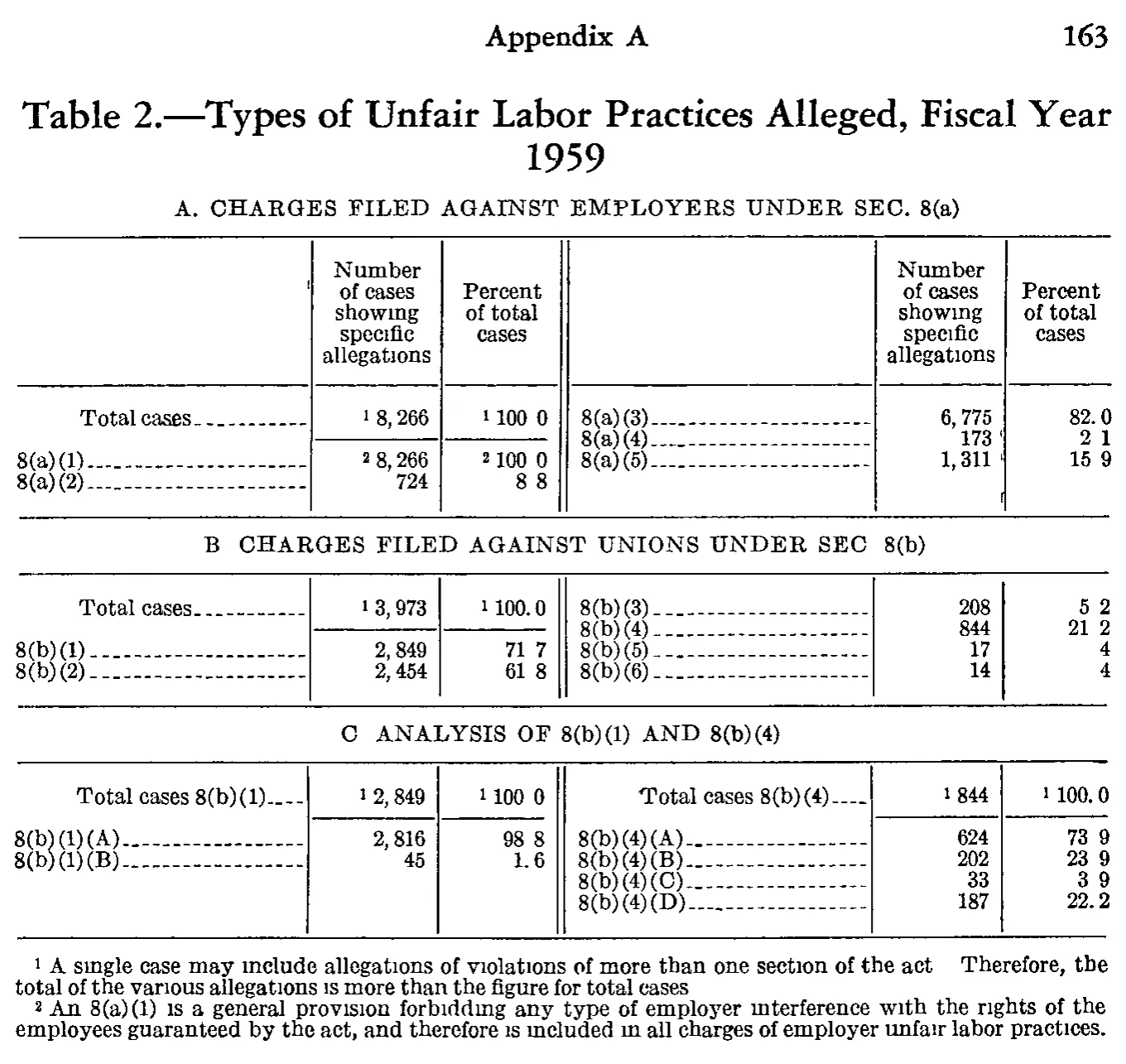
Types of Unfair Labor Practices Alleged, Fiscal Year 1959
| Number of cases showing specific allegations | Percent of total cases | |
|---|---|---|
| A. CHARGES FILED AGAINST EMPLOYERS UNDER SEC. 8(a) | ||
| Total cases | 8,266 | 100.0 |
| 8(a)(1) | 8,266 | 100.0 |
| 8(a)(2) | 724 | 8.8 |
| 8(a)(3) | 6,775 | 82.0 |
| 8(a)(4) | 173 | 2.1 |
| 8(a)(5) | 1,311 | 15.9 |
| B. CHARGES FILED AGAINST UNIONS UNDER SEC. 8(b) | ||
| Total cases | 3,973 | 100.0 |
| 8(b)(1) | 2,849 | 71.7 |
| 8(b)(2) | 2,454 | 61.8 |
| 8(b)(3) | 208 | 5.2 |
| 8(b)(4) | 844 | 21.2 |
| 8(b)(5) | 17 | .4 |
| 8(b)(6) | 14 | .4 |
| C. ANALYSIS OF 8(b)(1) AND 8(b)(4) | ||
| Total cases 8(b)(1) | 2,849 | 100.0 |
| 8(b)(1)(A) | 2,816 | 98.8 |
| 8(b)(1)(B) | 45 | 1.6 |
| Total cases 8(b)(4) | 844 | 100.0 |
| 8(b)(4)(A) | 624 | 73.9 |
| 8(b)(4)(B) | 202 | 23.9 |
| 8(b)(4)(C) | 33 | 3.9 |
| 8(b)(4)(D) | 187 | 22.2 |
- 1 A single case may include allegations of violations of more than one section of the act. Therefore, the total of the various allegations is more than the figure for total cases.
- 2 An 8(a)(1) is a general provision forbidding any type of employer interference with the rights of the employees guaranteed by the act, and therefore is included in all charges of employer unfair labor practices.
0 of 21 figures sit in a row or column sum that works out.
Reader’s notes
p. 174. Layout: the table has three banner sections (A, B, C), and each section is set as two side-by-side panels sharing the single set of column headings printed at the top of section A. Following the two-panel rule, each section's left-panel rows are given first, then that section's right-panel rows, in the columns of one panel. So in section A the order is Total cases, 8(a)(1), 8(a)(2) (left panel), then 8(a)(3), 8(a)(4), 8(a)(5) (right panel); in section B, Total cases, 8(b)(1), 8(b)(2), then 8(b)(3)-8(b)(6); in section C, the left panel's "Total cases 8(b)(1)" block, then the right panel's "Total cases 8(b)(4)" block. The section banner lines carry no values. The stub column has no printed heading, so cell 0 of the single heading level is empty. Punctuation dropout: this is a coarse 1-bit scan and many periods have dropped out. In the percent column most decimal points print as a gap ("100 0", "8 8", "2 1", "15 9", "71 7", "61 8", "5 2", "21 2", "98 8", "73 9", "23 9", "3 9"), while a few survive ("82.0", "100.0" in section B, "1.6", "22.2", "100. 0" in section C right panel). Since the column is uniformly one-decimal percentages and the surviving periods confirm the format, I have written all of them with a decimal point. The two 8(b)(5) and 8(b)(6) percent cells print as a bare "4" sitting in the tenths position, i.e. ".4" with the leading period lost (17/3,973 and 14/3,973 are both about 0.4 percent); I transcribed them as ".4". For the same reason the periods after "B" and "C" in the section banners, which do not survive in the scan but are present after "A", were restored; likewise the sentence periods inside footnote 1. Footnote 1 also renders "the" as "tbe" twice in the scan; this is a scanning artifact, not the printed word. Arithmetic check: every percent is consistent with its count divided by the relevant total, so the column assignment should be reliable. Footnote 1 explains that allegation counts exceed total cases, so the percent columns sum to more than 100 by design.
Source image
Source data: U.S. NLRB Annual Reports (public domain). Reconstruction by NLRB Stats Archive. Read by claude-opus-5 (effort max, prompt extract_v1) from the 300-dpi scan; stitched by page. Updated October 2026.