NLRB Stats Archive › Annual Reports › FY1956 › Collective-Bargaining Elections by Affiliation of Participating Unions, Fiscal Year 1956
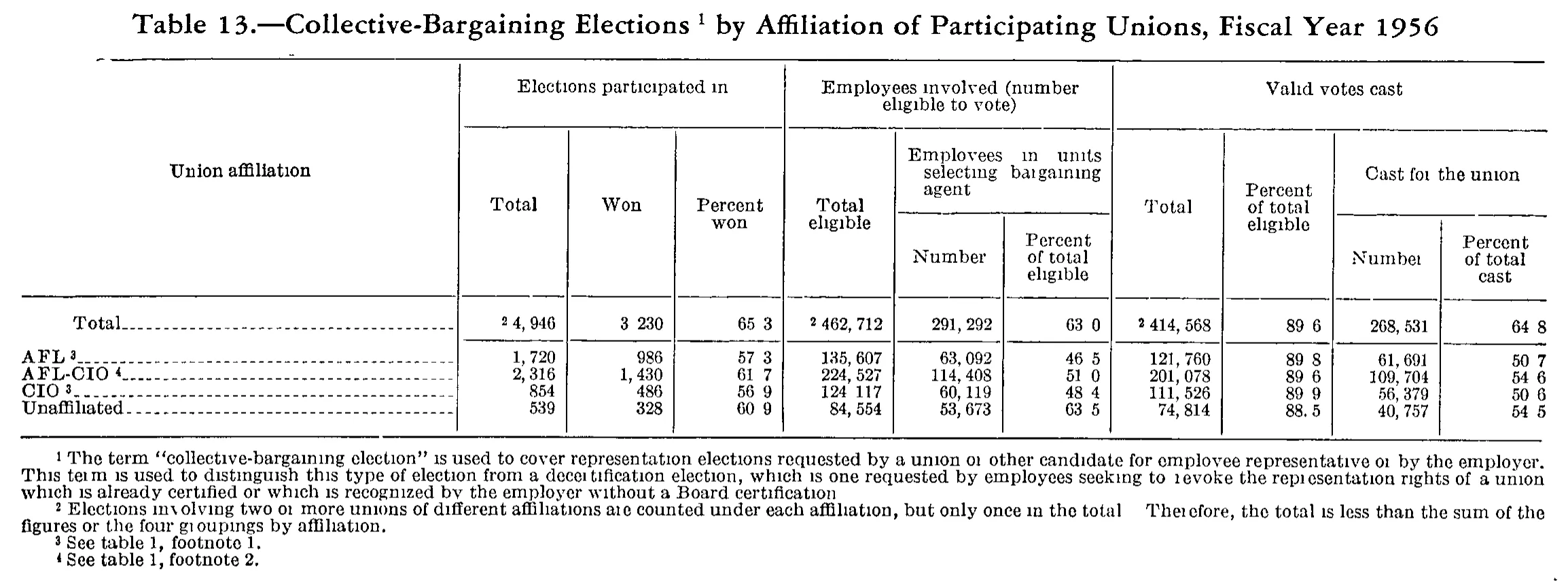
Collective-Bargaining Elections by Affiliation of Participating Unions, Fiscal Year 1956
| Union affiliation | Elections participated in | Employees involved (number eligible to vote) | Valid votes cast | |||||||
|---|---|---|---|---|---|---|---|---|---|---|
| Union affiliation | Total | Won | Percent won | Total eligible | Employees in units selecting bargaining agent | Total | Percent of total eligible | Cast for the union | ||
| Union affiliation | Total | Won | Percent won | Total eligible | Number | Percent of total eligible | Total | Percent of total eligible | Number | Percent of total cast |
| Total | 4,946 | 3,230 | 65.3 | 462,712 | 291,292 | 63.0 | 414,568 | 89.6 | 268,531 | 64.8 |
| AFL | 1,720 | 986 | 57.3 | 135,607 | 63,092 | 46.5 | 121,760 | 89.8 | 61,691 | 50.7 |
| AFL-CIO | 2,316 | 1,430 | 61.7 | 224,527 | 114,408 | 51.0 | 201,078 | 89.6 | 109,704 | 54.6 |
| CIO | 854 | 486 | 56.9 | 124,117 | 60,119 | 48.4 | 111,526 | 89.9 | 56,379 | 50.6 |
| Unaffiliated | 539 | 328 | 60.9 | 84,554 | 53,673 | 63.5 | 74,814 | 88.5 | 40,757 | 54.5 |
- 1 The term "collective-bargaining election" is used to cover representation elections requested by a union or other candidate for employee representative or by the employer. This term is used to distinguish this type of election from a decertification election, which is one requested by employees seeking to revoke the representation rights of a union which is already certified or which is recognized by the employer without a Board certification
- 2 Elections involving two or more unions of different affiliations are counted under each affiliation, but only once in the total. Therefore, the total is less than the sum of the figures for the four groupings by affiliation.
- 3 See table 1, footnote 1.
- 4 See table 1, footnote 2.
0 of 30 figures sit in a row or column sum that works out.
Reader’s notes
p. 188. 11 columns: stub plus 3 under "Elections participated in", 3 under "Employees involved (number eligible to vote)", and 4 under "Valid votes cast". Decimal points in the percent columns are very faint or dropped in this scan (most read as e.g. "65 3", "63 0", "50 7"); only "88.5" in the Unaffiliated row prints a clear point. All of these columns are one-decimal percentages and every value reproduces from its own numerator and denominator, so they are transcribed with the decimal point restored. Likewise the digit-grouping comma is faint in a few cells, e.g. "3 230" (Total/Won) and "124 117" (CIO/Total eligible); transcribed as 3,230 and 124,117. The raised 2 is printed before the value in three Total-row cells (Elections Total, Total eligible, Valid votes cast Total); per convention it is written after the number as ^2. Arithmetic checks all pass as printed: Won (986+1,430+486+328=3,230), units-selecting-agent Number (=291,292) and Cast-for-union Number (=268,531) sum exactly to the Total row; the other three Total cells are smaller than their column sums, as footnote 2 explains. Footnote text uncertainties: in footnote 2 the word before "the four groupings" is blurred and reads as either "or" or "for"; "for" is used as the sense requires. The sentence-ending period after "only once in the total" in footnote 2 and after "Board certification" at the end of footnote 1 did not print legibly; the former is supplied, the latter left off.
Source image
Source data: U.S. NLRB Annual Reports (public domain). Reconstruction by NLRB Stats Archive. Read by claude-opus-5 (effort max, prompt extract_v1) from the 300-dpi scan; stitched by page. Updated October 2026.