NLRB Stats Archive › Annual Reports › FY1952 › Collective bargaining elections by affiliation of participating unions, fiscal year 1952
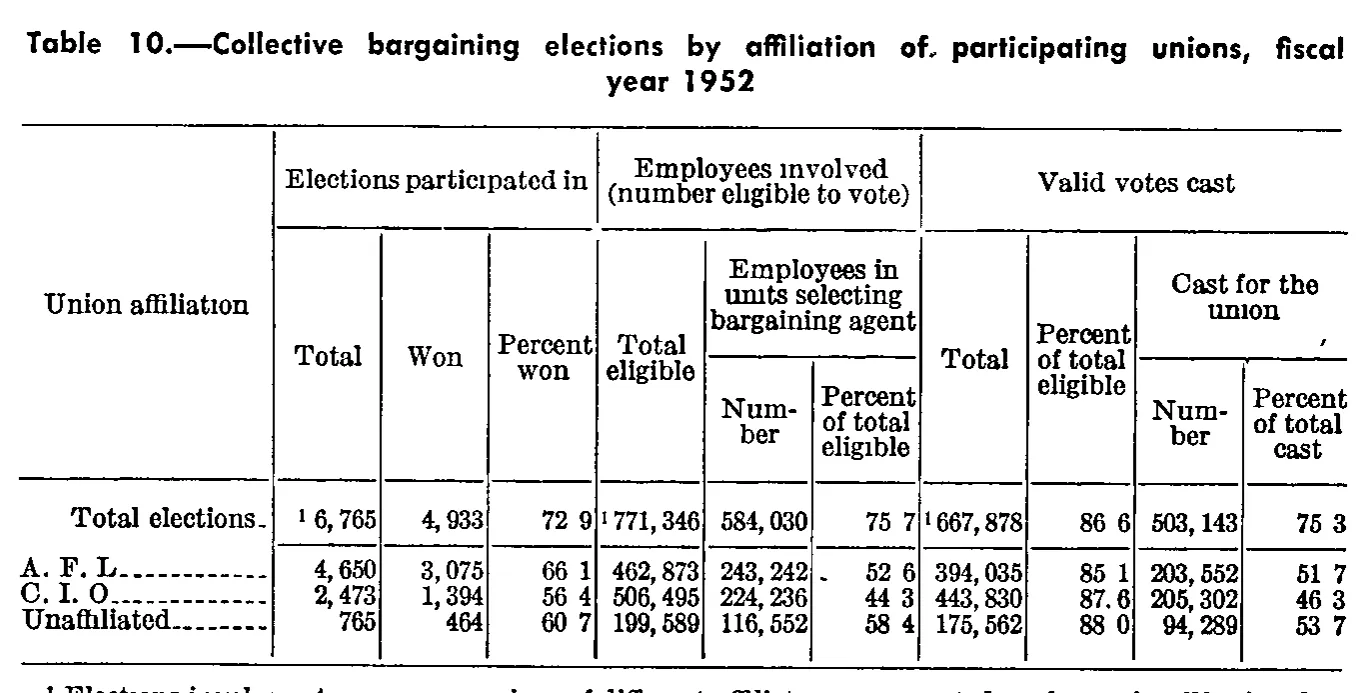
Collective bargaining elections by affiliation of participating unions, fiscal year 1952
| Union affiliation | Elections participated in | Employees involved (number eligible to vote) | Valid votes cast | |||||||
|---|---|---|---|---|---|---|---|---|---|---|
| Union affiliation | Total | Won | Percent won | Total eligible | Employees in units selecting bargaining agent | Total | Percent of total eligible | Cast for the union | ||
| Union affiliation | Total | Won | Percent won | Total eligible | Number | Percent of total eligible | Total | Percent of total eligible | Number | Percent of total cast |
| Total elections | 6,765 | 4,933 | 72.9 | 771,346 | 584,030 | 75.7 | 667,878 | 86.6 | 503,143 | 75.3 |
| A. F. L. | 4,650 | 3,075 | 66.1 | 462,873 | 243,242 | 52.6 | 394,035 | 85.1 | 203,552 | 51.7 |
| C. I. O. | 2,473 | 1,394 | 56.4 | 506,495 | 224,236 | 44.3 | 443,830 | 87.6 | 205,302 | 46.3 |
| Unaffiliated | 765 | 464 | 60.7 | 199,589 | 116,552 | 58.4 | 175,562 | 88.0 | 94,289 | 53.7 |
- 1 Elections involving two or more unions of different affiliations are counted only once in all columns.
0 of 24 figures sit in a row or column sum that works out.
Reader’s notes
p. 300. Eleven columns: stub plus three groups (Elections participated in = 3 cols; Employees involved = 3 cols; Valid votes cast = 4 cols). DECIMAL POINTS: in this 1-bit scan the decimal point is dropped in nearly every percent cell, which is printed as e.g. "72 9", "75 7", "86 6", "66 1", "52 6", "85 1", "51 7", "56 4", "44 3", "46 3", "60 7", "58 4", "88 0", "53 7". Only "87.6" (C. I. O., Valid votes cast - Percent of total eligible) shows the point clearly. I have written all of them with a decimal point (72.9, 75.7, ...) on the assumption that the glyph failed to reproduce; if strict glyph fidelity is wanted, read each as the two digit groups separated by a space. ROW LABELS: "A. F. L." and "C. I. O." run straight into their leader dots, so the final period of each abbreviation cannot be distinguished from the first leader dot; I have written it as part of the label. FOOTNOTE: the single footnote line sits at the very bottom edge of the crop and only the upper halves of its letters are visible, so the wording given is a best-effort reading and the sentence may continue beyond the crop. Treat the footnote text as uncertain; the marker (superscript 1) and its three attachment points in the "Total elections" row are legible and certain. MARKERS: in the "Total elections" row a raised 1 is printed immediately before 6,765, 771,346 and 667,878; recorded as trailing ^1. ARITHMETIC: the "Total elections" figures are smaller than the sum of the three affiliation rows (e.g. 4,650 + 2,473 + 765 = 7,888 vs. 6,765 printed; 462,873 + 506,495 + 199,589 = 1,168,957 vs. 771,346 printed). Transcribed as printed; footnote 1 accounts for this (elections with unions of more than one affiliation counted once in the total). A stray ink speck sits just left of "52.6" in the A. F. L. row (Employees in units selecting bargaining agent - Percent of total eligible); it is dirt, not a footnote marker. A similar stray apostrophe-like mark appears at the right edge of the "Cast for the union" heading band. Caption ("Table 10.-Collective bargaining elections by affiliation of participating unions, fiscal year 1952") omitted as instructed.
Source image
Source data: U.S. NLRB Annual Reports (public domain). Reconstruction by NLRB Stats Archive. Read by claude-opus-5 (effort max, prompt extract_v1) from the 300-dpi scan; stitched by page. Updated October 2026.