NLRB Stats Archive › Annual Reports › FY1952 › Results of Litigation for Enforcement or Review of Board Orders, July 1, 1951, to June 30, 1952, and July 5, 1935, to June 30, 1952
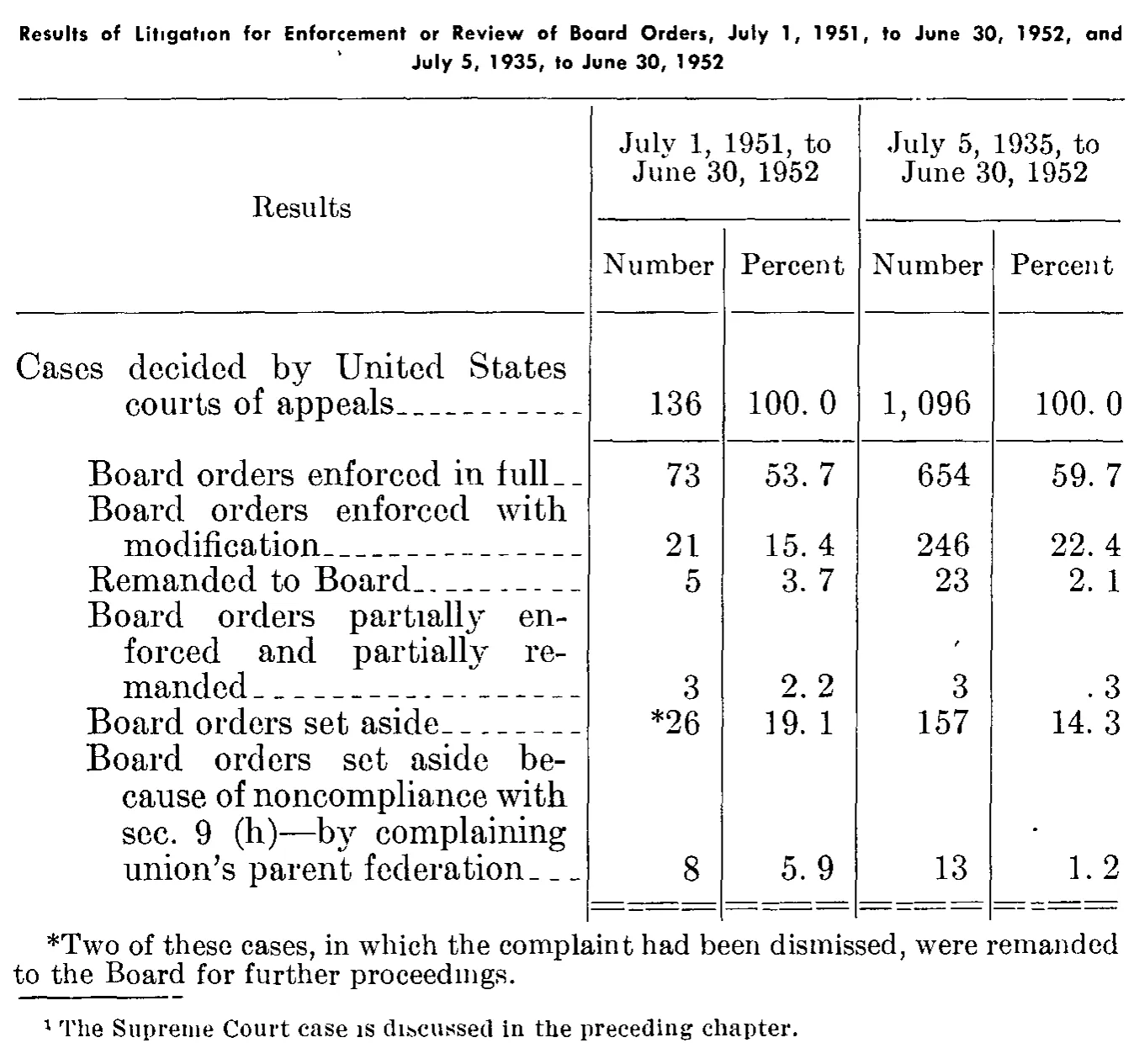
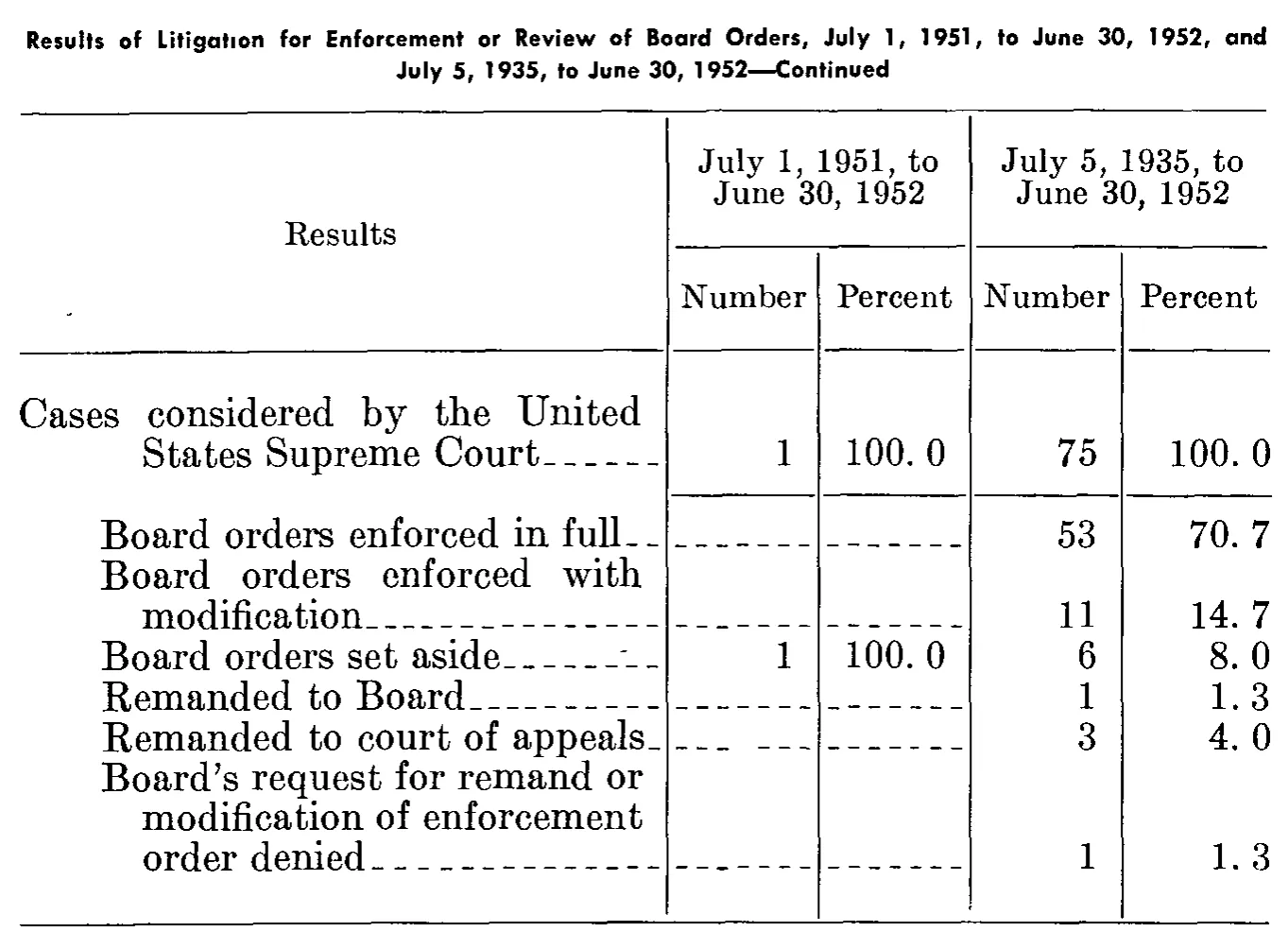
Results of Litigation for Enforcement or Review of Board Orders, July 1, 1951, to June 30, 1952, and July 5, 1935, to June 30, 1952
Stitched from pp. 225–226.
| Results | July 1, 1951, to June 30, 1952 | July 5, 1935, to June 30, 1952 | ||
|---|---|---|---|---|
| Results | Number | Percent | Number | Percent |
| Cases decided by United States courts of appeals | 136 | 100.0 | 1,096 | 100.0 |
| Board orders enforced in full | 73 | 53.7 | 654 | 59.7 |
| Board orders enforced with modification | 21 | 15.4 | 246 | 22.4 |
| Remanded to Board | 5 | 3.7 | 23 | 2.1 |
| Board orders partially enforced and partially remanded | 3 | 2.2 | 3 | .3 |
| Board orders set aside | 26 | 19.1 | 157 | 14.3 |
| Board orders set aside because of noncompliance with sec. 9 (h)—by complaining union's parent federation | 8 | 5.9 | 13 | 1.2 |
| Cases considered by the United States Supreme Court | 1 | 100.0 | 75 | 100.0 |
| Board orders enforced in full | 53 | 70.7 | ||
| Board orders enforced with modification | 11 | 14.7 | ||
| Board orders set aside | 1 | 100.0 | 6 | 8.0 |
| Remanded to Board | 1 | 1.3 | ||
| Remanded to court of appeals | 3 | 4.0 | ||
| Board's request for remand or modification of enforcement order denied | 1 | 1.3 | ||
- *Two of these cases, in which the complaint had been dismissed, were remanded to the Board for further proceedings.
- 1 The Supreme Court case is discussed in the preceding chapter.
0 of 23 figures sit in a row or column sum that works out.
Reader’s notes
p. 225. Five columns: stub plus two periods, each with Number and Percent. The asterisk on the first-period count for \"Board orders set aside\" is printed before the figure (*26); it is transcribed as a marker (26^*). The percent cell for \"Board orders partially enforced and partially remanded\" in the July 5, 1935–June 30, 1952 panel is printed as a bare decimal (. 3), transcribed \".3\". The second footnote (\"1 The Supreme Court case...\") sits below a short separator rule and is probably a page footnote for the surrounding text rather than a table footnote; it has no corresponding marker anywhere in the table, but it is printed under the table on this crop so it is included. The first-period percents sum to 100.0 only approximately as printed (53.7+15.4+3.7+2.2+19.1+5.9 = 100.0; the 1935–1952 column gives 59.7+22.4+2.1+0.3+14.3+1.2 = 100.0); nothing was computed or altered. No leader-dot or dash-rule cells other than those rendered as \"\" (none occur in the body).
p. 226. Five columns: stub plus Number/Percent under each of the two date spans. The decimal values are printed with a space after the point ("100. 0", "70. 7"); transcribed without the space. Cells shown as dash rules in the first panel (Number/Percent for the rows other than "Board orders set aside") are given as empty strings. The caption carries a "—Continued" line, so this is a continuation page; the body of this crop ends after the "Board's request for remand or modification of enforcement order denied" row, below which is only the closing rule. In the 1935-1952 panel the detail percentages (70.7 + 14.7 + 8.0 + 1.3 + 4.0 + 1.3 = 100.0) and counts (53 + 11 + 6 + 1 + 3 + 1 = 75) agree with the 75 / 100.0 total as printed.
Source image
Source data: U.S. NLRB Annual Reports (public domain). Reconstruction by NLRB Stats Archive. Read by claude-opus-5 (effort max, prompt extract_v1) from the 300-dpi scan; stitched by page. Updated October 2026.