NLRB Stats Archive › Annual Reports › FY1951 › Results of union-shop authorization polls conducted Aug. 22, 1947-Oct. 22, 1951
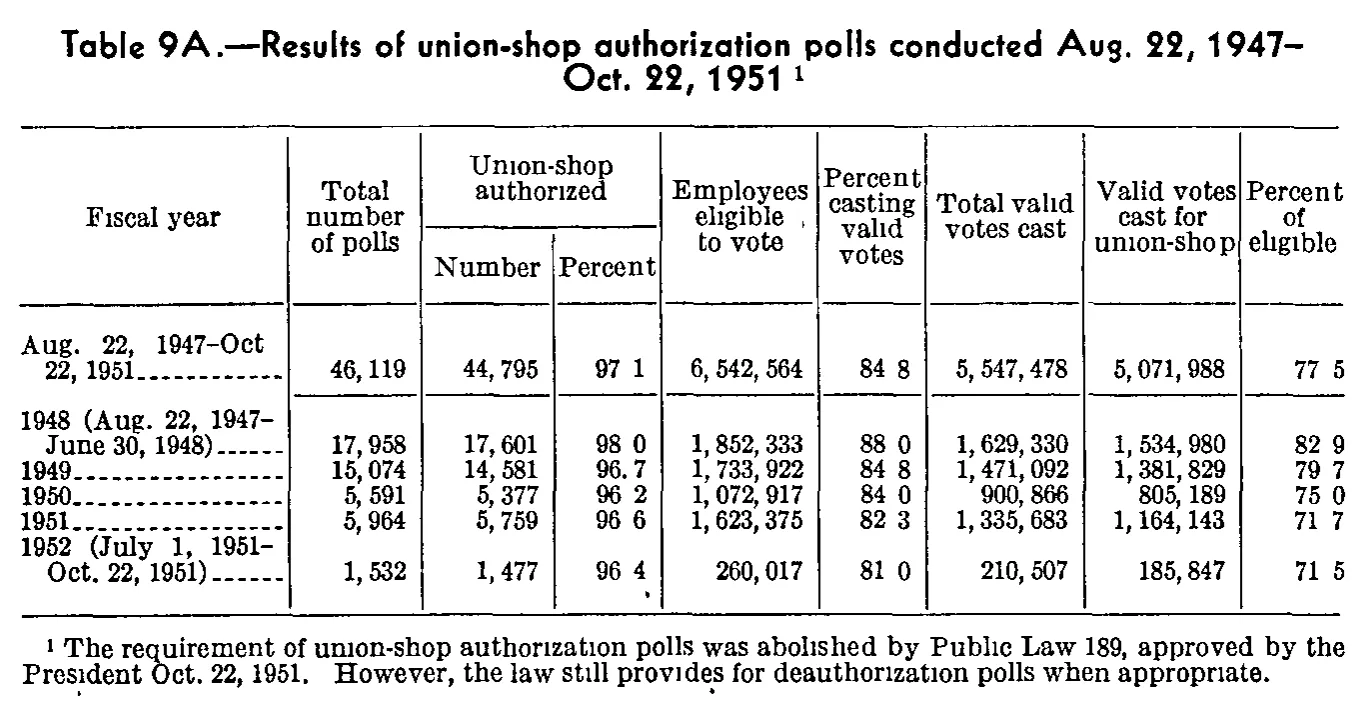
Results of union-shop authorization polls conducted Aug. 22, 1947-Oct. 22, 1951
| Fiscal year | Total number of polls | Union-shop authorized | Employees eligible to vote | Percent casting valid votes | Total valid votes cast | Valid votes cast for union-shop | Percent of eligible | |
|---|---|---|---|---|---|---|---|---|
| Fiscal year | Total number of polls | Number | Percent | Employees eligible to vote | Percent casting valid votes | Total valid votes cast | Valid votes cast for union-shop | Percent of eligible |
| Aug. 22, 1947-Oct. 22, 1951 | 46,119 | 44,795 | 97.1 | 6,542,564 | 84.8 | 5,547,478 | 5,071,988 | 77.5 |
| 1948 (Aug. 22, 1947-June 30, 1948) | 17,958 | 17,601 | 98.0 | 1,852,333 | 88.0 | 1,629,330 | 1,534,980 | 82.9 |
| 1949 | 15,074 | 14,581 | 96.7 | 1,733,922 | 84.8 | 1,471,092 | 1,381,829 | 79.7 |
| 1950 | 5,591 | 5,377 | 96.2 | 1,072,917 | 84.0 | 900,866 | 805,189 | 75.0 |
| 1951 | 5,964 | 5,759 | 96.6 | 1,623,375 | 82.3 | 1,335,683 | 1,164,143 | 71.7 |
| 1952 (July 1, 1951-Oct. 22, 1951) | 1,532 | 1,477 | 96.4 | 260,017 | 81.0 | 210,507 | 185,847 | 71.5 |
- 1 The requirement of union-shop authorization polls was abolished by Public Law 189, approved by the President Oct. 22, 1951. However, the law still provides for deauthorization polls when appropriate.
30 of 30 figures sit in a row or column sum that works out.
Reader’s notes
p. 314. Nine columns: stub plus eight data columns; the "Union-shop authorized" spanner covers the Number and Percent columns, all other headings are tall single headings spanning both heading levels. The first body row (Aug. 22, 1947-Oct. 22, 1951) is the all-period total line, set off by a rule from the by-fiscal-year rows below it. Decimal points: in this scan the decimal point in the percentage columns (Percent authorized, Percent casting valid votes, Percent of eligible) is dropped almost everywhere, printing as e.g. "97 1", "84 8", "77 5"; only 1949's "96.7" shows the point clearly. I have transcribed all of them with a decimal point, since the values are one-decimal percentages and the gap is plainly a faded point, not a space. The stub label of the first row reads "Aug. 22, 1947-Oct 22, 1951" in the image, with no visible period after "Oct" (the wrap falls between "Oct" and "22"); I transcribed it as "Oct." on the assumption the period faded like the decimal points above. The dashes joining the date ranges are en dashes in print; transcribed as hyphens. The scan is a 1-bit JBIG2-style render in which dots over "i" are frequently lost ("Fiscal", "Union-shop", "eligible" appear dotless); this affects only letterforms, not digits. No digits were doubtful. The caption carries footnote marker 1, which ties to the single printed footnote.
Source image
Source data: U.S. NLRB Annual Reports (public domain). Reconstruction by NLRB Stats Archive. Read by claude-opus-5 (effort max, prompt extract_v1) from the 300-dpi scan; stitched by page. Updated October 2026.