NLRB Stats Archive › Annual Reports › FY1943 › Old and new run-off election policy
Old and new run-off election policy
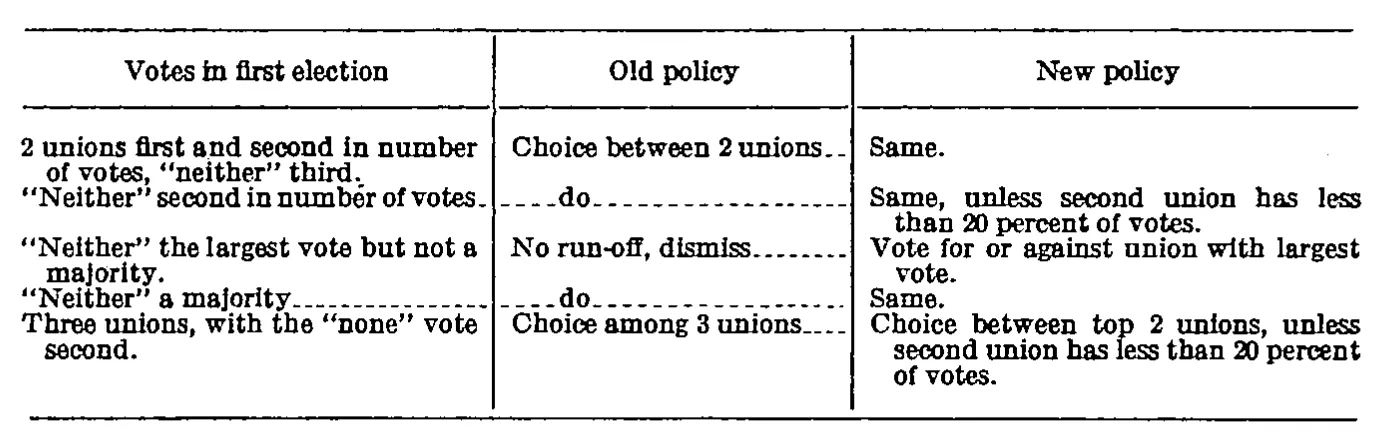
| Votes in first election | Old policy | New policy |
|---|---|---|
| 2 unions first and second in number of votes, "neither" third. | Choice between 2 unions | Same. |
| "Neither" second in number of votes | do | Same, unless second union has less than 20 percent of votes. |
| "Neither" the largest vote but not a majority. | No run-off, dismiss | Vote for or against union with largest vote. |
| "Neither" a majority | do | Same. |
| Three unions, with the "none" vote second. | Choice among 3 unions | Choice between top 2 unions, unless second union has less than 20 percent of votes. |
Reader’s notes
p. 22. This is a textual comparison table (no numeric data), with 3 columns divided by vertical rules: stub "Votes in first election", "Old policy", "New policy". The "Old policy" cells in rows 2 and 4 are printed as ditto entries ("- - - do - - - - -"); the surrounding leader dots were dropped and only "do" is transcribed, meaning "Choice between 2 unions" and "No run-off, dismiss" respectively. Row labels and entries that wrap over two or three printed lines were joined into one line (e.g. row 1, row 3, row 5, and the "New policy" entries in rows 2, 3 and 5). The original uses typographic curly quotation marks around "neither"/"none"; they are rendered here as straight double quotes. Trailing periods are kept where printed and omitted where the entry is followed only by leader dots. No footnotes are printed under the table, and nothing appears cut off by the crop.
Source image
Source data: U.S. NLRB Annual Reports (public domain). Reconstruction by NLRB Stats Archive. Read by claude-opus-5 (effort max, prompt extract_v1) from the 300-dpi scan; stitched by page. Updated October 2026.