NLRB Stats Archive › Annual Reports › FY1939 › Trend of man-days of idleness due to strikes compared with trend of business activity, January 1935-June 1939
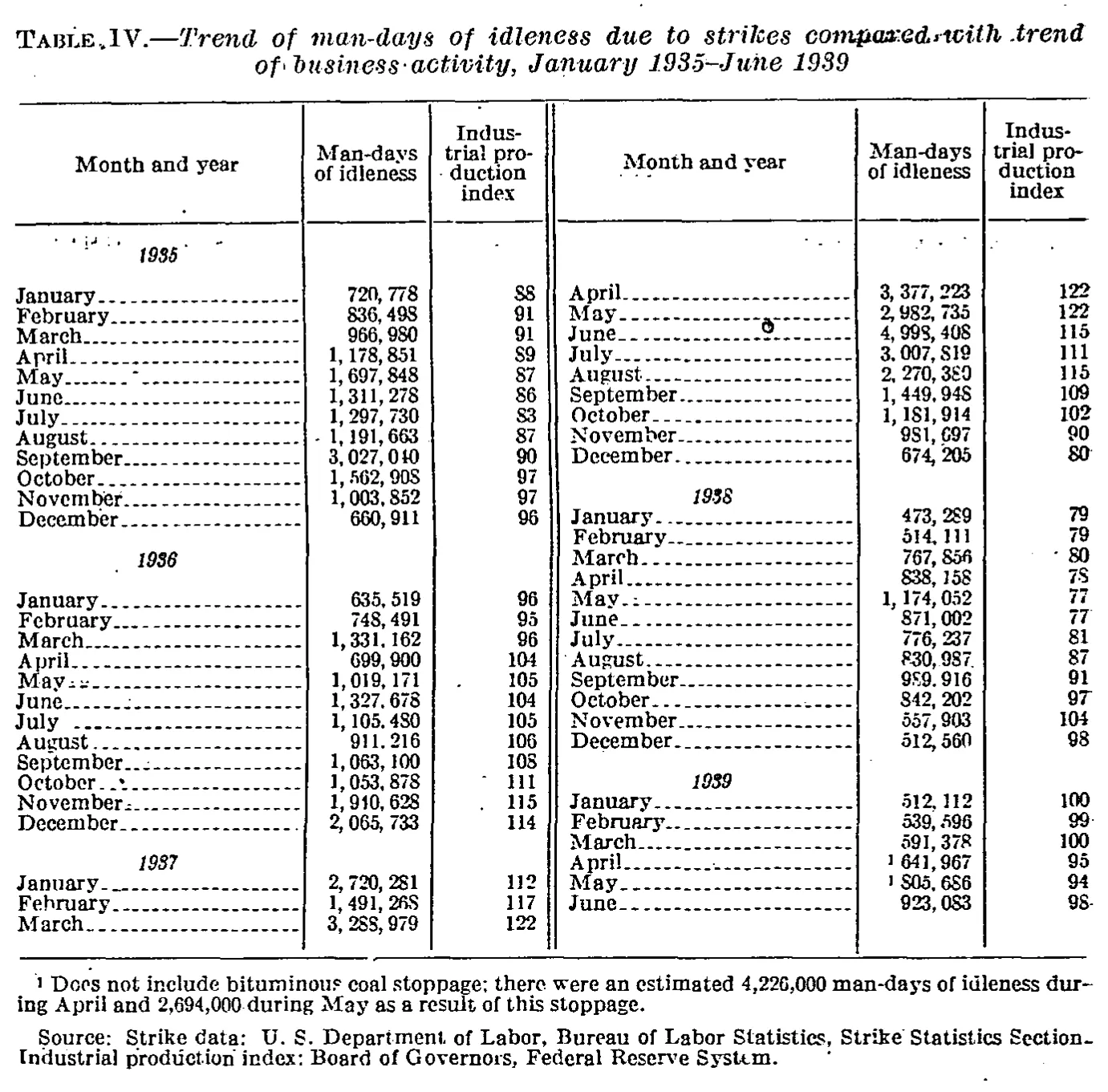
Trend of man-days of idleness due to strikes compared with trend of business activity, January 1935-June 1939
| Month and year | Man-days of idleness | Industrial production index |
|---|---|---|
| 1935 | ||
| January | 720,778 | 88 |
| February | 836,498 | 91 |
| March | 966,980 | 91 |
| April | 1,178,851 | 89 |
| May | 1,697,848 | 87 |
| June | 1,311,278 | 86 |
| July | 1,297,730 | 83 |
| August | 1,191,663 | 87 |
| September | 3,027,040 | 90 |
| October | 1,562,908 | 97 |
| November | 1,003,852 | 97 |
| December | 660,911 | 96 |
| 1936 | ||
| January | 635,519 | 96 |
| February | 748,491 | 95 |
| March | 1,331,162 | 96 |
| April | 699,900 | 104 |
| May | 1,019,171 | 105 |
| June | 1,327,678 | 104 |
| July | 1,105,480 | 105 |
| August | 911,216 | 106 |
| September | 1,063,100 | 108 |
| October | 1,053,878 | 111 |
| November | 1,910,628 | 115 |
| December | 2,065,733 | 114 |
| 1937 | ||
| January | 2,720,281 | 112 |
| February | 1,491,268 | 117 |
| March | 3,288,979 | 122 |
| April | 3,377,223 | 122 |
| May | 2,982,735 | 122 |
| June | 4,998,408 | 115 |
| July | 3,007,819 | 111 |
| August | 2,270,389 | 115 |
| September | 1,449,948 | 109 |
| October | 1,181,914 | 102 |
| November | 981,697 | 90 |
| December | 674,205 | 80 |
| 1938 | ||
| January | 473,289 | 79 |
| February | 514,111 | 79 |
| March | 767,856 | 80 |
| April | 838,158 | 78 |
| May | 1,174,052 | 77 |
| June | 871,002 | 77 |
| July | 776,237 | 81 |
| August | 830,987 | 87 |
| September | 959,916 | 91 |
| October | 842,202 | 97 |
| November | 557,903 | 104 |
| December | 512,560 | 98 |
| 1939 | ||
| January | 512,112 | 100 |
| February | 539,596 | 99 |
| March | 591,378 | 100 |
| April | 641,967 | 95 |
| May | 805,686 | 94 |
| June | 923,083 | 98 |
- 1 Does not include bituminous coal stoppage; there were an estimated 4,226,000 man-days of idleness during April and 2,694,000 during May as a result of this stoppage.
- Source: Strike data: U. S. Department of Labor, Bureau of Labor Statistics, Strike Statistics Section. Industrial production index: Board of Governors, Federal Reserve System.
0 of 54 figures sit in a row or column sum that works out.
Reader’s notes
p. 205. The table is printed as two side-by-side panels with the same three headings; I have stacked them, left panel first (1935 through March 1937), then the right panel (April 1937 through June 1939). The right panel opens directly with "April" and carries no repeated "1937" year line, so the nine rows from April to December 1937 sit under the "1937" section line transcribed from the left panel; no year label was invented. The italic centered year lines 1935, 1936, 1937, 1938 and 1939 are label-only section rows. Digit-grouping separators: in several man-days cells the thousands comma has lost its tail in this 1-bit scan and prints like a period (1936 March 1,331,162; 1936 July 1,105,480; 1936 August 911,216; 1938 September 959,916). All other values in that column use commas, so I have written commas throughout; no decimal point is intended. Doubtful cell: 1938 September, Man-days of idleness. The middle digit of the leading group is degraded and could be read as 5 or 8, i.e. 959,916 or 989,916; I transcribed 959,916. The index figure 91 beside it is clear. Footnote markers: the raised 1 is printed to the LEFT of the value in the 1939 April and 1939 May man-days cells; per convention I placed it after the number as ^1. The crop is complete: caption, both panels, the closing rule, footnote 1 and the source line are all present. A stray ink speck sits in the leader dots of the right panel's June 1937 row label; it is not a character. The 1939 February index reads 99 with a stray mark after it, and the 1938 March index reads 80 with a stray mark before it; neither is a footnote marker.
Source image
Source data: U.S. NLRB Annual Reports (public domain). Reconstruction by NLRB Stats Archive. Read by claude-opus-5 (effort max, prompt extract_v1) from the 300-dpi scan; stitched by page. Updated October 2026.